Thursday, May 29, 2008

Vince Young is Restless

For a few days now, I've been thinking about this story about Vince Young and his thoughts about retirement after his rookie year. I could not decide what to make of it - overly honest? overly dramatic? not a big deal? a huge deal?

Then I read this story about over-the-hill baseball players who cannot come to terms with retirement and still hope to find a team this season (the article leaves out a few names - Barry Bonds and Trot Nixon being glaring omissions).

(An aside - am I the only person who finds the "announced his retirement" headlines about guys like Bret Boone and Julio Franco to be ridiculous? Did they really retire or could they no longer find a job? Isn't that different?)

Back to my original point, the baseball articles convinced me that Vince Young's retirement confession is, in fact, a big deal for the Tennessee Titans. If he seriously thought about walking away from the game after one season, what does it say about his love of the game? What does it say about his desire to succeed?

If Vince Young was Tony Soprano and I was Dr. Melfi, here is what I would say about my patient: Vince is a charismatic guy who loves the spotlight that being a football quarterback provides, but does not actually care much about football itself.

Deep, huh?

We found out from Vince's Texas days and his Wunderlic test scores that he is not the sharpest knife in the drawer. Some have speculated that being an NFL quarterback is just too mentally tough for him. I don't buy that. Playing football is not rocket science - Vince is given a play that is practiced over and over again throughout the week. He makes a few reads and then either runs it, throws it or hands it off. Peyton Manning makes the position look like a professorship, but dumb guys can play quarterback in the NFL.

I think it has less to do with his intellect and more to do with his passion. Rather than loving football, Vince loves attention. He loves the admiration. He had it at Madison High School where he was highly recruited and easily BMOC. He had it at UT after a rocky start where he was a highly touted and BMOC. In the NFL, he is a run-of-the-mill quarterback on a run-of-the-mill team. The spotlight is on guys like Brady, Manning (take your pick) and Favre.

So Vince realized that his athleticism, size and skill sets were not enough to make him BMOC in the NFL; he was going to have to work hard to achieve it. His first instinct was to quit. I wonder if that feeling will return again. What happens if the Titans struggle to a 5-11 season this year with Young getting the brunt of the blame? Will his instinct be to improve or pack it in and hang with his boys?

Baseball has a starting line-up of guys who are dying to get back on the field, but Vince Young pondered quitting after one year. The question for the Titans is: Can they can win with a quarterback who does not really like football?

If that question was on the Wunderlic test, even Vince would get it right.

Wednesday, May 28, 2008

Braves Fall to 0-11 in One Run Games on Road

Exasperating.

Chipper Tracker - Larry Wayne Goes For .400

Chipper was 1 for 2 on Wednesday night.

Current Average - .418

The Milwaukee/Atlanta Connection

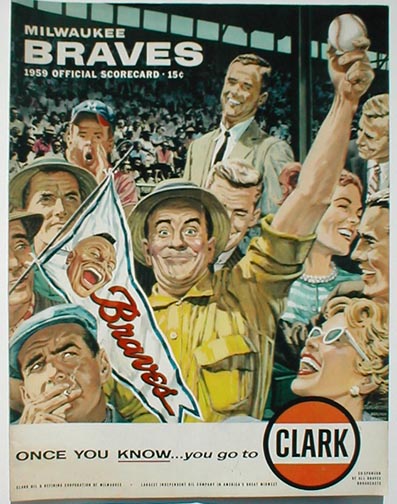
While my students take their final exams in American history, I have been doing a little history myself about the history of the Braves franchise. The Braves moved from Boston to Milwaukee to Atlanta, forever linking the three cities in baseball history. The Braves battle the Red Sox each year in interleague play for this very reason, and it makes a series like the one in Milwaukee this week more special because of the lineage.

The central connection between the two cities in many minds is Hammerin' Hank Aaron. The former homerun king started slugging in Milwaukee, moved with the Braves to Atlanta to hit #715, then returned to Milwaukee as a Brewer to finish his Hall of Fame career. Aaron's story links the two cities just like the Braves franchise, but what exactly is the history of that franchise?

The Braves started in Boston alongside the more popular Red Sox. Despite a pennant in 1948 (the famous "Spahn and Sain and two days of rain" team), the Braves followed several other teams, like the Giants, Dodgers and Athletics, to the growing populations of western cities. Milwaukee earned the Braves in 1953 after years of support for minor league baseball. The city also promised a state of the art stadium for the Braves.

The 1950s featured some of the best teams in Braves' history with superstars like Spahn, Aaron and Eddie Mathews. They won back-to-back pennants in 1957 and 1958, winning the World Series over the New York Yankees in 1957 for their only championship (they lost to the Yanks, despite a 3-1 series lead, in 1958). In fact, the Milwaukee Braves never had a losing record during their stay in Wisconsin.

Despite a championship and consistent winning product, attendance dropped after the '57 championship. There do not seem to be good explanations for what happened to baseball in Milwaukee. Some suggest the city was always partial to the teams in Chicago over their own Braves, while others suggest the city simply lost its fascination with baseball over time.

Either way, the Braves' ownership saw an opportunity to move the team to a growing population in Atlanta, Georgia. The Braves would be the only MLB team in the South and play in a new stadium. There were concerns about moving to Atlanta among players who worried about the humidity as well as racial segregation in the South, but the paltry game attendance in Milwaukee made it difficult for anyone to fight to save the franchise.

Anyone besides used car salesman Bud Selig. The future commish successfully sued to keep the Braves in Milwaukee through its lease in 1965. It only delayed the inevitable as the Braves were heading for Atlanta despite hopes to keep the team in Wisconsin. The final year of the Braves' stay in Milwaukee was a miserable one as there were often less than a thousand fans at the games. Only 812 people paid to watch the final game of the franchise's existence in Milwaukee.

Bud Selig fought to bring baseball back to Milwaukee despite the city's pathetic record with the Braves and succeeded in 1970 when the Seattle Pilots became the Milwaukee Brewers. The Brewers franchise has failed to achieve the same success as the Braves, making its lone appearance in the World Series in 1982 (a seven-game loss to St. Louis) and switching from the American to the National League in 1998.

The Braves franchise, of course, has had tremendous success in Atlanta because of its geographic monopoly on baseball, the superstation TBS and the development of young players in the farm system.

The Braves and Brewers - forever linked in Milwaukee baseball history.

Braves Blow It Against Brewers

I was excited about watching last night's game in Milwaukee. Not for the sausage races or to see Billy Brewer slide into the beer, but because the Braves were heading away from Turner Field after an excellent homestand to hopefully bash their road bugaboos.

It started well with a run in the first and another shortly thereafter on the Gregor Blanco homerun (his 1st career dinger), but fell apart late in the game. Tim Hudson was brilliant, but could not hold his lead late and the bullpen gave up the go-ahead run in the 9th for a deflating 3-2 loss to Milwaukee.

You just knew it would be Bill Hall in the end, didn't you? After being benched and making public comments about it, the demoted infielder got a less-than-impressive broken bat hit, moved to second base on a fielder's choice, stole third when Jeff Bennett inexplicably forgot about him and then scored on a sacrifice fly to end it.

There is an old adage in baseball that you win 60, you lose 60, and whatever you do in-between determines your season. Last night was a game that should have been a W, but became another road loss (the Braves are now 6-17 away from Turner Field).

What is especially frustrating are the multiple mental and strategic mistakes that led to the loss. For example:

* Bennett forgetting about Bill Hall on 2nd base - he stole 3rd and scored on a sac fly because of the uncontested swipe.

* Swinging at first and bad pitches - the announcers, who are almost always spot on with their commentary these days, pointed out that Yunel Escobar made three outs on first pitches...from the leadoff spot! He had never faced Dave Bush before - take a pitch or two! Mark Teixeira grounded into a double play when he reached for a bad first pitch in the 8th. The Braves too often show no plate patience.

* Not understanding situations - after Tim Hudson gutted his way through a tough 6th inning, Jeff Francoeur led off the 7th with an out on the first pitch. Matt Diaz followed that with an inexplicable bunt (after hurting his knee in the outfield the previous inning) on the first pitch to make the second out. Two pitches, two outs. Gregor Blanco did his job and battled a few pitches to give Hudson a rest, but Frenchy and Diaz ought to know better than to hack after a long defensive inning.

* The Diaz bunt - huh? Even with good wheels, he shouldn't be bunting. Like many Atlanta fans, I've soured on Diaz as of late. I cannot remember the last time I saw him hit the ball hard. Joe Simpson alluded to Diaz's poor play when he called for Omar Infante to get ready to play some left field which now looks like a reality because Diaz is heading to the D.L. with a posterior cruciate ligament strain.

These types of mistakes get you beat on the road. Last night was one for the taking as Tim Hudson was working the Brewers' hitters, but a series of mistakes cost Atlanta.

Lots of news:

Rafael Soriano will be activated today off the D.L. The already-solid bullpen just got its closer back.

Matt Diaz is on the D.L. I like Gregor Blanco, but I really like Omar Infante because he can bat leadoff.

Mark Kotsay was scratched again yesterday and will likely head to the D.L. if things don't improve. This is bad news as this injury kept him out much of last year as well.

Jo-Jo works tonight against the right-handed hitting Brew Crew. Bad news...

Chipper Tracker - Larry Wayne Goes For .400

Chipper went 2-4 yesterday.

Current Average - .418

Tuesday, May 27, 2008

Ball Four - Today's Tiny Strike Zone

Unable to locate the remote control at the conclusion of yesterday's victory over the Diamondbacks, I was treated to a quick interview session with Bobby Cox after the game. I was quickly struck with how exhausted he seemed after the game. He seems so calm throughout, just sitting there taking it all in. It is easy to forget how much the manager lives and dies with each sequence during the game.

The main topic of Cox's post-game thoughts was the game's strike zone. This is the elephant in the room right now for Major League Baseball. The games are too long, pitchers are throwing too many pitches and ruining their arms, and the hitters are allowed to take strikes with the knowledge that even behind in the count they will get something to hit.

The source of Cox's anger yesterday was a borderline strike to Eric Byrnes that would have ended the inning and given Jair Jurrjens a victory. Byrnes, who looks lost at the plate right now despite a couple of homers in the series, was clearly fooled by the inside pitch and should have been rung up. Instead, the Braves' rookie had to throw a better pitch that was laced for a hit. His day was over after 97 squeezed pitches.

Why has the strike zone gotten so small? On paper, the zone is supposed to be from the letters to the knees, but in actuality it is called from the waist to the top of the knees. You never see a high strike called anymore.

The problems with such a tight zone are many. The New York Yankees began a strategy that has been mirrored throughout the league of taking pitches to get into an opponent's bullpen. With strike zones so small, this strategy works well against any pitcher, even ones with good control. It forces the pitcher to sweeten up his pitches just to get ahead in the count which leads to big offensive innings. The alternative is to keep after the corners and run up a big pitch count while falling behind hitters.

The tight zone also lengthens the game. If every batter is getting 2-2, 3-2 counts, the time of the game quickly balloons to three, maybe four hours long. I love watching baseball, but not four hours of it.

What about the pitchers' arms? The list of arm and elbow problems among elite pitchers is so long I don't know where to start. It is known that the overhand pitch in an unnatural motion that tears up a man's shoulder and elbow, but don't you think there is also a connection between the sheer number of pitches thrown and the damage done? It takes 15-20 pitches to get out of an inning these days - and that is a good inning! Complete games are as rare as triple plays not because of the new closer strategy, but because the human arm cannot throw as many pitches as today's tight zone demands.

Why not expand the zone? The quick answer is that it would favor the pitcher too much and produce a bunch of 1-0 games. Ladies love the longball, right? People want to see homeruns and power at the plate. The game would be less exciting.

Here is why that is lousy logic: the current zone leads to bat-on-the-shoulder patience that is not exciting at all. The MLB once had wider strike zones that meant batters went to the plate ready to swing the bat. Isn't that better than today's game where batters go to the plate ready to take until the first strike?

Bobby Cox was right on the money yesterday with his critique of game right now in regards to the calling of balls and strikes. Widen that zone and we get a much better brand of baseball.

Braves Spin Webb, Split With D-Backs

Atlanta finished its homestand 8-3 with a split of the Arizona Diamondbacks by knocking off Brandon Webb 7-3 on Memorial Day. The game looked like a solid pitching match-up between Atlanta's upstart rookie Jair Jurrjens and Arizona's Cy Young winner Brandon Webb, but a tight strikezone and hot bats knocked both pitchers out early.

The big play in the game was Brian McCann's solo homer to lead off the bottom of the 5th inning. The Diamondbacks had scored two runs in the top of the inning and knocked Jurrjens from the game, but with one swing McCann halted any Arizona momentum as he crushed a Webb offering into the right-center stands.

The Atlanta bullpen continues to be the most pleasant surprise of the year thus far. It did not give up a single run yesterday in protecting the early lead. Unfortunately, it did not protect a win for Jair Jurrjens who did not complete the minimum five innings for the W.

Mark Kotsay was a late scratch with back soreness. Seriously, can we get the Phoenix Suns' training staff down in Atlanta? It is easier to name Braves who AREN'T hurt than ones who are.

Atlanta visits Milwaukee to face the scary Brewers. It seems like those guys could get hot at any time, so hopefully it won't be this weekend. Speaking of scary, I'm a fan of the Diamondbacks. With that starting staff and young line-up, they will be a pain for somebody in the playoffs (in the pathetic N.L. West, I think their magic number is already 12). Fingers crossed it won't be Atlanta.

The Braves need to start winning on the road and have a host of right-handed pitchers waiting for them in Milwaukee and then Cincinnati. Time to win a few away from Turner Field.

Chipper Tracker - Larry Waynes Goes For .400

Chipper went 1 for 3 with a couple of walks.

Current Average - .417

Monday, May 26, 2008

My Manu Crush

It's true - I've got a Manu Crush.

Manu Ginobili that is. The San Antonio Spurs' sensation from Argentina used to drive me nuts with his flopping and whining, but I've come around on him over the last few weeks.

Why the change of heart? The Manu of Old annoyed my manly sensibilities with his flailing and faking every time he drew the slightest bit of contact. The New Manu charms me with his fearless drives into the lane and ability to finish among the trees.

The Manu of Old traveled every time he took it to the basket. The New Manu's European crossover is the most innovative finisher in the game (I would love to teach it to my players, but no middle/high school referee in America is going to believe it isn't a walk).

The Manu of Old was overly efficient and boring with the ball. The New Manu is dribbling between legs - other player's legs! - to get to the basket.

The Manu of Old struck me as a constant victim and complainer. The New Manu manned up after the Game 2 loss to shoulder the blame for the defeat (were you listening, Tracy McGrady?).

I have a love/hate relationship with most international players and their brand of basketball. There is a beauty to their game in that they are multi-dimensional, cerebral and ultra-competitive. This cannot be said about many, if not most, American players who specialize a skill (shooter, rebounder, defender) and compete during contract years only.

There is also an ugliness to their game. They tend to be the worst floppers and whiners in the league (Varajao, Ginobili, Nocioni). They make an effort to get under the skin of their defensive assignment in the hopes of drawing a retaliation - a prevalent strategy in soccer and hockey, but not American basketball.

The love/hate relationship I have with internationals is mirrored in my Manu feelings. Last night, I was won over with affection. Manu was the Man against L.A. with outside shooting and fearless drives to the bucket. A flop here and there is no worse than a prima donna American player's tendency to occasionally mail one in. I'm learning to forgive and forget the foreigners' flaws.

We live in a global society. The World Is Flat, you know? I'm expanding my mind like John Davis as I find the goodness in the NBA's international superstars.

Quite the Memorial Day lesson, huh?